
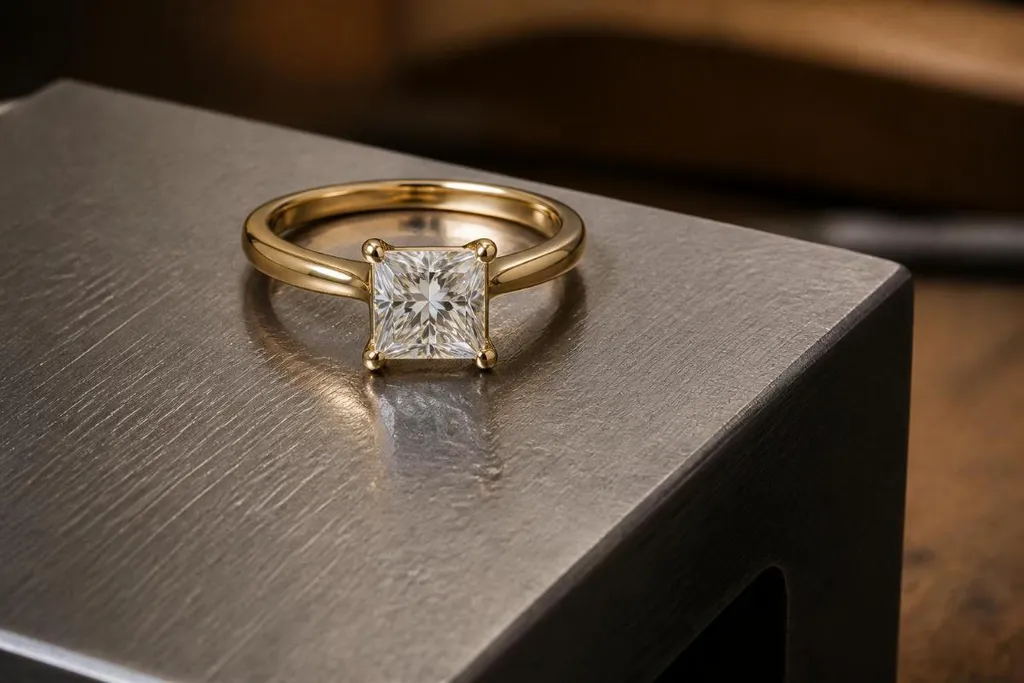
The princess cut has a distinctive visual tension: its outline is crisp and architectural, yet its faceting creates lively brilliance rather than the restrained flashes associated with many geometric cuts. That combination makes it an appealing choice for someone who wants an engagement ring with modern structure without sacrificing noticeable sparkle.
Browsing beautiful lab diamond princess cut rings demonstrates how much the setting influences this shape. A princess-cut lab diamond can look strikingly minimal on a plain band, more luminous with diamond-set shoulders, or distinctly glamorous within a detailed setting. Whatever the style, the square outline, pointed corners and relationship between the diamond and band deserve careful consideration.
Why the Princess Cut Looks So Distinctive
Unlike a round brilliant, the princess cut is defined by straight sides and sharp corners. Viewed from above, it usually presents a square or near-square outline, creating strong symmetry and a clean sense of order.
Its internal appearance is considerably more energetic. Brilliant-style faceting produces numerous reflections, giving the stone the sparkle many buyers want while maintaining its geometric silhouette. This separates the princess cut from step-cut shapes such as the emerald cut, where longer facets create broader, calmer flashes.
The contrast works particularly well in contemporary engagement ring designs. The diamond has enough structure to make an impression without requiring an elaborate setting, yet its brilliance prevents a minimalist ring from feeling austere.
For buyers who appreciate precise lines but still want movement and light, that balance is difficult to replicate with another shape.
Look at Proportion, Not Carat Weight Alone
Carat measures diamond weight, but it does not tell you exactly how large a princess-cut stone will appear from above. Depth and dimensions affect the amount of visible surface area, so two diamonds of the same carat weight may not present identically once set.
The relationship between length and width is also worth examining. Someone seeking a classic princess silhouette will generally prefer a stone that appears convincingly square rather than noticeably rectangular. Good symmetry helps reinforce the clean geometry that gives the cut its character.
A 2-carat princess-cut lab diamond may appeal because its width provides a stronger visual presence that balances a substantial band or larger hand. Another wearer may prefer a 1-carat or 1.5-carat centre stone because its proportions create a cleaner, more understated composition.
Neither decision is simply about having more or less diamond. The important question is whether the scale of the centre stone looks intentional within the complete ring.
The Setting Needs to Protect the Corners
The pointed corners are among the princess cut's defining features, but they also require thoughtful protection. A secure setting should safeguard these areas without hiding so much of the diamond that its square outline becomes unclear. Claw placement therefore matters. Settings designed specifically for princess-cut diamonds can provide protection at the corners while leaving the straight sides visually open.
A solitaire offers perhaps the purest expression of the shape. With little surrounding detail, the geometry becomes the main feature. Diamond-set shoulders introduce additional brilliance and can soften the transition from the square centre stone into the band.
More decorative designs can work equally well, but proportion becomes increasingly important. If surrounding diamonds or metalwork are too dominant, the precision of the centre stone may lose some of its impact.
Use Metal and Band Design to Set the Mood
Metal choice can push a princess-cut ring towards either a crisp contemporary aesthetic or something warmer. Platinum and white gold complement the diamond's cool brilliance and can create an almost continuous visual transition between stone and setting. Yellow gold introduces clear contrast, making the square outline more pronounced. Rose gold softens the overall effect while retaining the modern geometry.
Band width is another useful styling tool. A slim band can make the centre diamond appear particularly prominent, whereas a wider band produces a more substantial architectural composition. Everyday wear should influence the final decision too. Setting height, overall profile and compatibility with a future wedding band all matter for a ring intended to be worn regularly rather than simply admired.
Final Thought
Princess-cut lab diamond rings combine two qualities that do not always appear together: disciplined geometry and lively brilliance. Their clean square outline creates a contemporary foundation, while brilliant faceting brings energy to the design.
Choosing one successfully means paying attention to symmetry, dimensions, corner protection and the proportions of the setting. When those elements work together, the princess cut delivers a ring that feels precise and modern without losing the light and character expected from an engagement diamond.